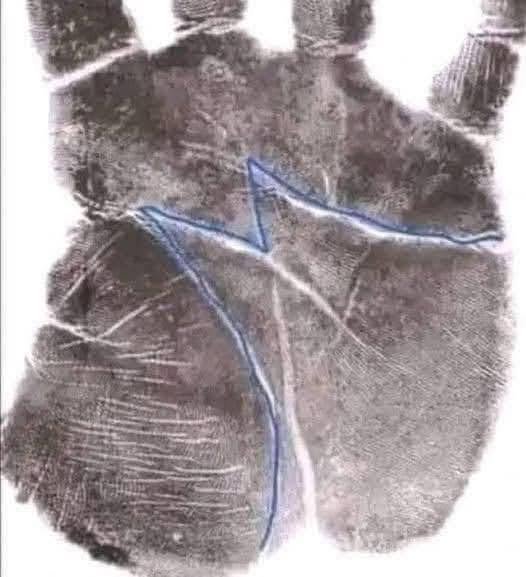
The “M” shape on the palm is not a rare sign of special luck, wealth, or destiny—it is a completely normal anatomical pattern formed by the intersection of your natural palmar flexion creases (the folds where your skin bends when you grasp objects).
What Actually Forms the “M”
Those lines develop in the womb (around week 12 of gestation) so your palm skin folds smoothly without bunching up when you close your hand. In palmistry, the four lines that connect to form an “M” are simply the major creases almost everyone has:
-
Heart line (top horizontal crease under the fingers)
-
Head line (middle crease across the palm)
-
Life line (curved crease wrapping around the base of the thumb)
-
Fate line (vertical crease running up the center of the palm—the only line that varies in visibility from person to person)
| Perspective | What the “M” Represents |
| Medical & Anatomical Reality | Standard skin-fold geometry caused by fetal hand movement and genetics. Having an “M” (or not having one) has no link to health, intelligence, lifespan, or personality. |
| Palmistry & Viral Folklore | Traditionally interpreted as a symbol of strong intuition, good fortune, leadership, or honesty—a claim designed to feel flattering because a huge portion of the population has this exact crease layout. |
Why Viral Posts Make It Sound Rare
-
The Barnum effect: Clickbait posts describe the “M” as “extremely rare” and pair it with broad, universally appealing traits (“you can spot lies easily,” “big success awaits you”) so readers share it.
-
Normal anatomical variation: Whether your creases form a distinct “M” depends purely on whether your vertical center crease (fate line) is deep enough to bridge your head and heart lines—a harmless genetic variation, much like having attached vs. detached earlobes.
(Note: While an “M” crease is completely normal, doctors do occasionally note a single transverse palmar crease—where the head and heart lines merge into one straight line across the palm—as a benign variation that occurs in ~1–3% of the general population and is also associated with certain congenital conditions like Down syndrome.)